Business

EDI for growing businesses: less paperwork, fewer errors

Electronic Data Interchange replaces manual re-entry of orders and invoices. Here is what it is and when it makes sense.

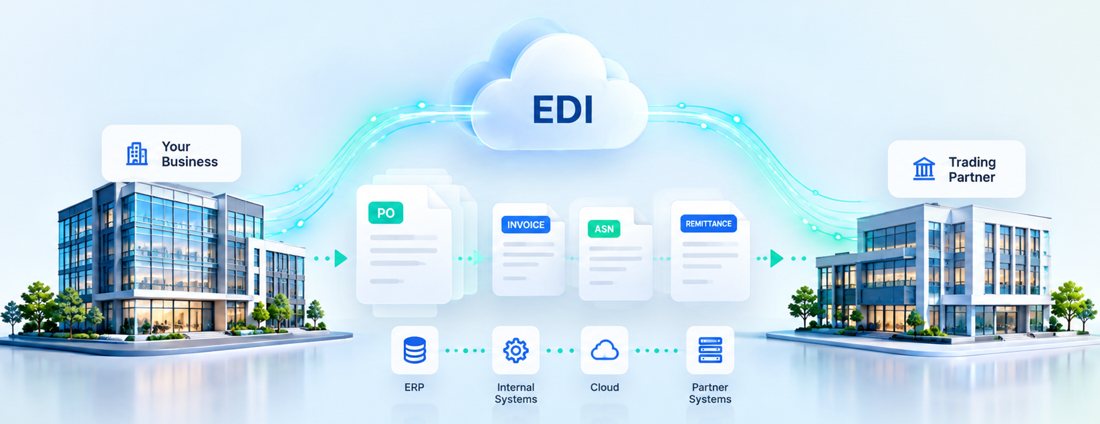
EDI cloud exchanging purchase orders, invoices and remittances between a business and its trading partner

What is EDI?

Electronic Data Interchange (EDI) is the exchange of business documents — such as purchase orders, invoices and shipping notices — between organisations in a structured, electronic format, instead of on paper or by email attachment.

Why businesses use it

The main benefits are practical:

  • Less manual data entry between systems
  • Fewer errors from re-typing orders and invoices
  • Faster document exchange with trading partners
  • Clearer records of what was sent and received

When it makes sense

EDI is most useful when you exchange a steady flow of documents with the same partners — for example distributors, suppliers and large buyers. It works best alongside the systems you already use, such as ERP and accounting software.

Getting started

Start by listing the documents you exchange most often and with whom. Our team can help you plan which documents to connect first.

Want to offer this at your business?Our team can walk you through the next steps.
All guides
KEEP READING

More guides

Banking
4 min read

What is AEPS and how does it help your customers?

A simple guide to the Aadhaar Enabled Payment System — how it works at an agent point and why it brings banking closer to people.

Payments
4 min read

Domestic Money Transfer: a counter-side guide

How DMT lets customers send money to bank accounts across India from your shop — and what to keep in mind while doing it.

Payments
3 min read

Micro ATM vs MPOS: which one does your business need?

Both are compact card devices, but they solve different problems. Here is how to tell them apart.

LET’S CONNECT

Ready to bring these services to your business?

Share your business details and the services you need. Our team will get back to you with the next steps.